

Rules & strategy
Sudoku Beginner Techniques: Start with Singles
Sudoku is a deduction puzzle, not an arithmetic test. Every row, column and 3 by 3 box must contain the digits 1 through 9 exactly once. A useful first habit is to explain why a digit belongs before entering it.
By Idea2Play · 2 min read · Updated
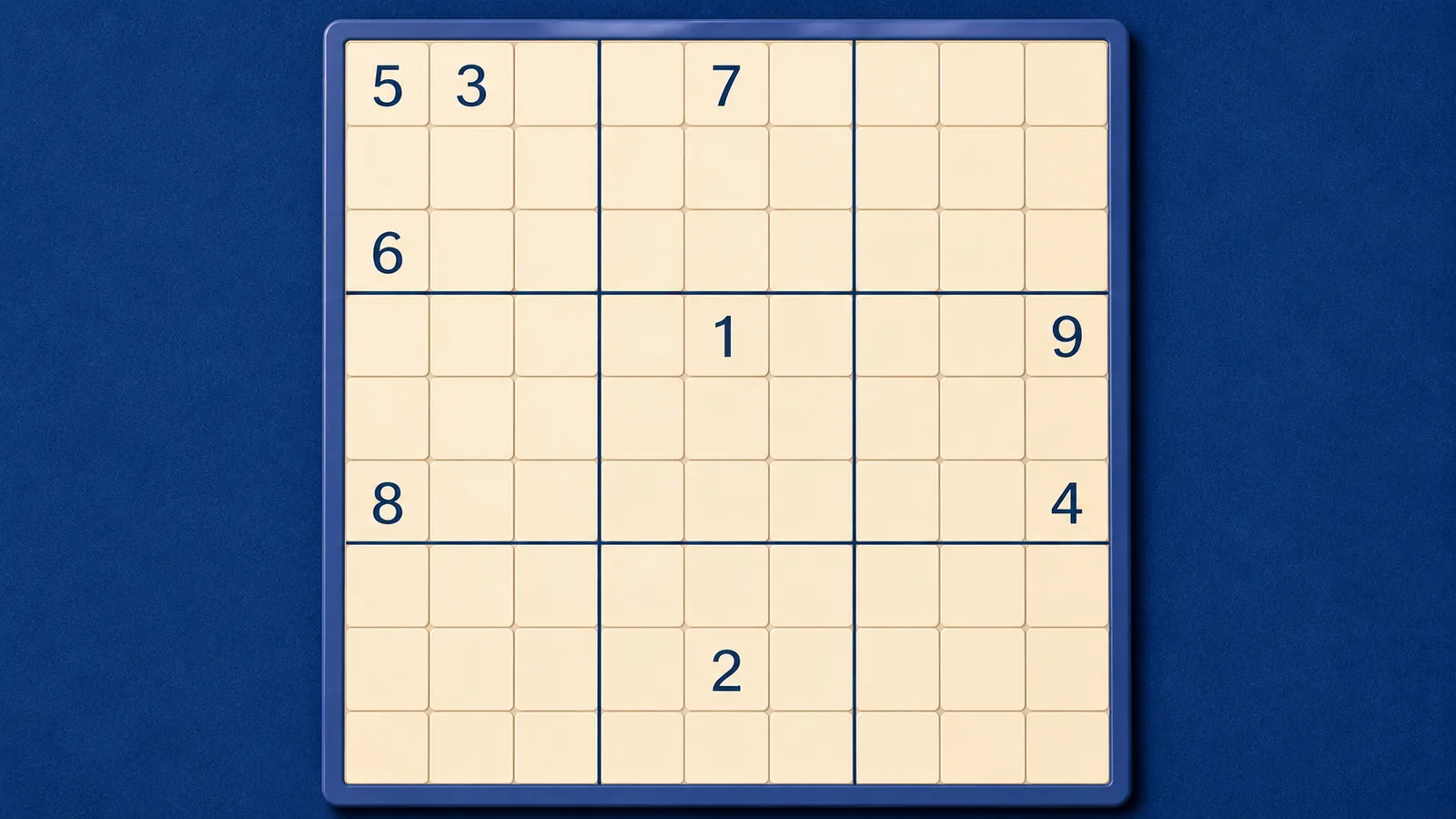
Find candidates by checking all three units
Choose an empty square and remove every digit already present in its row, column or box. The digits left are its candidates. A digit missing from the row is not automatically allowed: the other two units still matter.
Use notes as working possibilities
Idea2Play’s Notes mode records candidates without committing a value. Autofill Notes calculates possibilities from visible constraints; it does not solve the puzzle for you. Entering a digit removes the same candidate from its row, column and box peers.
- Start with a row, column or box that is nearly complete.
- Look for a square with one candidate, then look for a digit with one possible square.
- After placing a digit, revisit all three affected units.
- If nothing is forced, update notes or request a deduction hint instead of guessing.
Understand what error feedback proves
A duplicate is a clear conflict. An entry can also be wrong without creating a duplicate yet, so an unmarked square is not proof that your deduction was sound. Check Cell and Check Answer compare entries with the solution.
Start on Easy while learning these techniques. There is no mistake limit or time limit in ordinary play, and Undo and Redo include notes. Read a hint’s reasoning, then make the placement yourself.
Try it at the table
Pick one idea from the guide and try it in a game. You can play without an account.