

Rules & strategy
Minesweeper Patterns: Read the Numbers
Each revealed number counts mines in the touching squares, including diagonals. Your goal is to reveal every safe square. Flags are useful reminders, but placing flags alone never wins the game.
By Idea2Play · 2 min read · Updated
Start with two dependable deductions
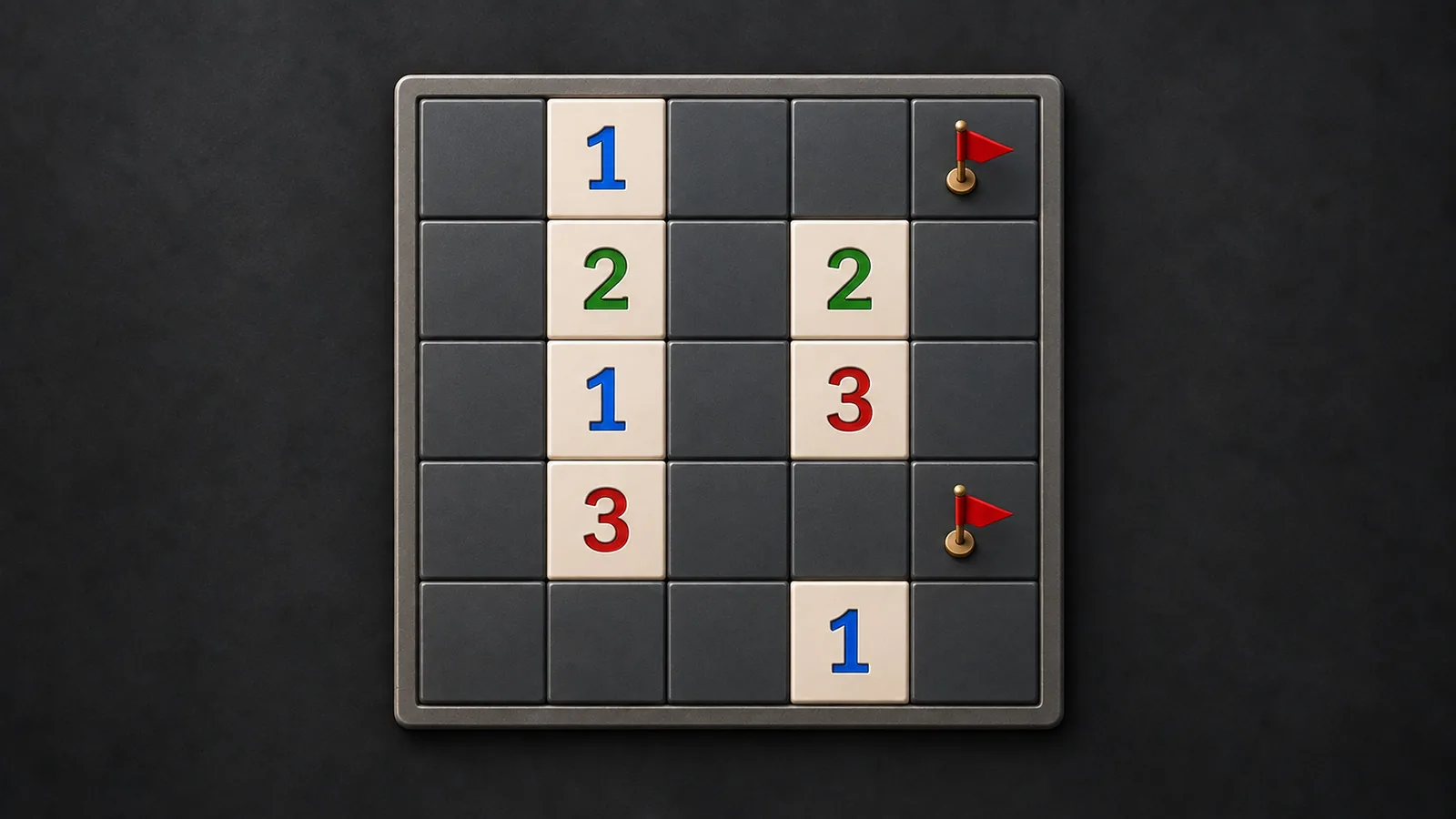
If a clue’s remaining mine count equals its number of unknown neighbors, all those neighbors must be mines. If all the mines around a clue have already been correctly identified, its other covered neighbors are safe.
Compare overlapping clues
Useful patterns come from relationships between neighbor sets, not just the shape of the printed numbers. Check every touching square before applying a remembered pattern.
Treat flags as claims you may need to revisit
Incorrect flags are allowed. The remaining-mine counter changes when you place a flag, but it cannot certify your reasoning. Normal hints assume the flags already on the board are correct.
Chording a revealed number opens its unflagged neighbors when the touching flag count matches the clue. It checks the count, not the accuracy of the flags: a mistaken flag can make a chord reveal a mine.
Try a patient first board
Beginner uses a 9 by 9 board with 10 mines. In this version, the first reveal keeps both the chosen square and its neighbors free of mines. That safe opening does not mean every later position offers an obvious forced move.
- Reveal a square and study the border of the opening.
- Flag only mines you can explain using the clues.
- Reveal squares proven safe, then recheck the changed frontier.
- If no deduction is available, avoid treating a guess as certainty. Undo can revisit reveals, flags and even endings in ordinary play.
Try it at the table
Pick one idea from the guide and try it in a game. You can play without an account.